
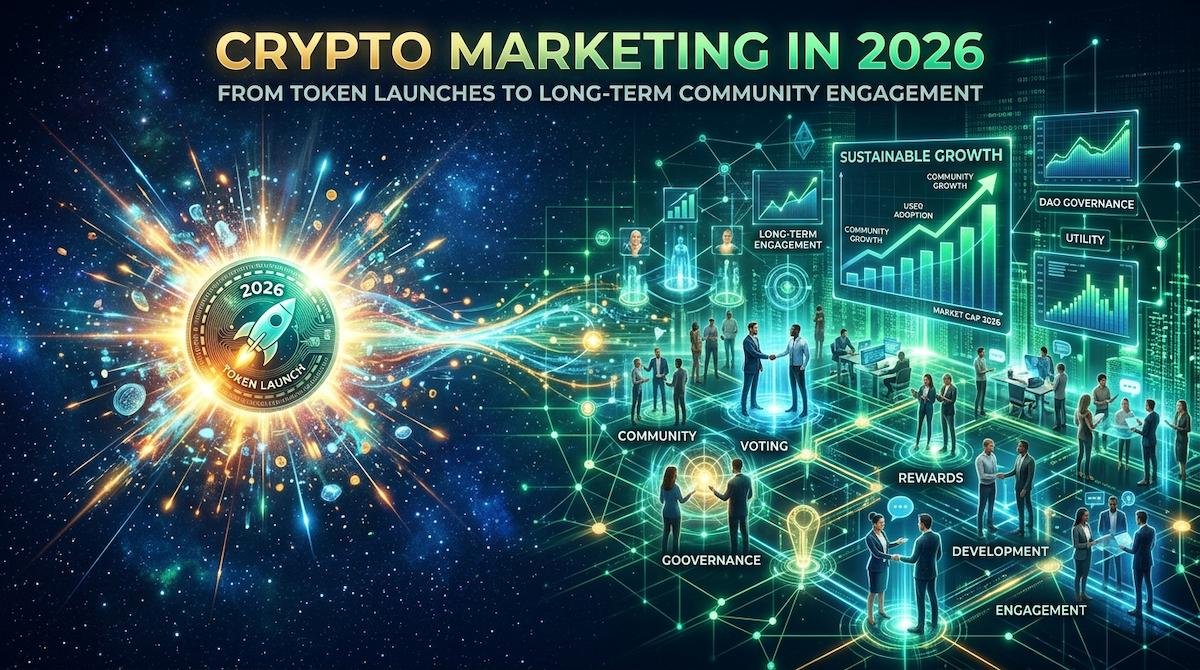
Crypto Marketing in 2026: From Token Launches to Long-Term Community Engagement
Crypto marketing in 2026 is no longer about creating short-lived hype around a token launch. The market has matured. Investors are more cautious, regulators are more active, and users expect proof before participation.
The strongest crypto brands now market like serious technology companies, not speculative meme machines.
Token launches still matter. But the real competition begins after listing, when projects must prove utility, retain users, and build communities that survive market cycles.
The Market Has Changed: Hype Alone Is Not a Strategy
Crypto audiences in 2026 are sharper than they were during earlier bull cycles. They have seen failed roadmaps, abandoned Discords, exploit headlines, and empty “community-first” promises.
A project now needs credibility before visibility.
Regulation shapes messaging
With frameworks such as MiCA in Europe and stronger stablecoin rules emerging across major markets, crypto marketing has become more compliance-aware. Claims around returns, staking yields, token value, and exchange listings need careful handling.
Marketing teams must now work closely with legal and compliance teams before major campaigns go live.
Institutional users expect clarity
Institutional adoption has pushed crypto messaging toward business value. Projects can no longer rely only on “decentralization” as a selling point. They need to explain:
- What problem the protocol solves
- Who uses it today
- Why the token is necessary
- How security risks are managed
- What makes the ecosystem defensible
Retail users demand proof
Retail users still respond to culture, memes, and rewards. But they also check tokenomics, vesting schedules, audits, founder history, and community sentiment before committing.
Trust is now a marketing asset.
Token Launch Marketing: From Noise to Precision
A token launch remains one of the most important moments in a crypto project’s lifecycle. It creates liquidity, attention, and community momentum. But in 2026, successful launches are built through sequencing, not shouting.
The best launches feel inevitable before they happen.
Build narrative before announcement
Strong projects start shaping the market narrative months before launch. They publish research, show product traction, onboard early users, and educate the market on why the token exists.
A launch campaign should answer one question clearly: why now?
Design airdrops for quality, not farming
Airdrops are still powerful, but low-effort farming has weakened their impact. Better campaigns reward meaningful participation, such as:
- Testnet usage
- Governance involvement
- Developer contributions
- Liquidity depth
- Long-term wallet behavior
The goal is not just distribution. It is aligned ownership.
Make tokenomics understandable
Complex tokenomics can kill trust. Users want plain-language explanations of supply, vesting, emissions, utility, and treasury allocation.
A good tokenomics campaign should simplify without hiding risk.
Coordinate launch channels
A modern launch usually spans X, Telegram, Discord, YouTube, podcasts, KOL campaigns, newsletters, launchpads, exchanges, and community calls.
The message must stay consistent across every channel.
Community Is No Longer a Chatroom
In earlier cycles, “community” often meant a large Telegram group and active meme posting. In 2026, community is closer to a product growth engine.
The best communities create education, liquidity, feedback, referrals, governance, and cultural identity.
Segment the community
Not every member wants the same thing. A strong crypto community separates audiences by intent:
- Traders want updates, catalysts, and liquidity information
- Developers want documentation and grants
- Holders want transparency and governance
- New users want education and onboarding
- Partners want ecosystem opportunities
One generic announcement channel is not enough.
Reward contribution, not noise
Projects should move beyond vanity engagement. Instead of rewarding spam, they should recognize contributors who create explainers, report bugs, host local meetups, translate content, onboard users, or support governance.
This turns community from audience into infrastructure.
Keep founders visible
Founder visibility matters in crypto because trust is personal. Regular AMAs, roadmap reviews, post-mortems, and transparent treasury updates help reduce uncertainty.
Silence creates speculation. Speculation damages confidence.
Use community feedback as product intelligence
Community managers should not only moderate conversations. They should collect recurring objections, product friction, user questions, and competitor mentions.
The community is often the fastest research department a project has.
Content Marketing Must Educate Before It Converts
Crypto buyers and users do not move through a simple funnel. They research across social platforms, dashboards, influencers, GitHub, whitepapers, and community channels.
That makes content strategy central to credibility.
Publish practical explainers
Projects should create content that explains real use cases, not just protocol features. For example, a DeFi project should show how users manage risk, compare strategies, and understand liquidity mechanics.
Useful content earns trust faster than promotional content.
Turn data into stories
On-chain data gives crypto marketers a major advantage. Wallet growth, protocol revenue, transaction volume, active users, TVL, retention, and governance activity can all become marketing assets.
But raw metrics are not enough. The story behind the metric matters.
Create founder-led thought leadership
Markets pay attention to operators with a clear point of view. Founder essays, market commentary, technical breakdowns, and ecosystem predictions can position a project as a category leader.
The strongest voice often wins the narrative.
Localize for growth markets
Crypto adoption is global. Markets such as India, Vietnam, Brazil, Pakistan, and parts of Africa and Latin America continue to show strong grassroots activity. A single English-language campaign misses major user bases.
Localization should include language, culture, regulation, payment habits, and platform preferences.
Influencer and KOL Marketing Needs More Discipline
KOL marketing remains important in crypto, but the old model of paying influencers for vague hype posts is losing effectiveness.
Audiences are better at detecting paid promotion.
Choose credibility over reach
A smaller analyst with a serious audience can outperform a large account known for paid shills. Projects should evaluate KOLs based on audience trust, topic fit, engagement quality, and past campaign outcomes.
The right messenger matters as much as the message.
Structure campaigns around education
The best KOL campaigns explain the project, compare it with alternatives, walk through the product, or analyze token design. Shallow posts may create short-term attention but rarely produce durable users.
Track wallet and community impact
Campaign success should not stop at impressions. Teams should measure referral traffic, wallet connects, Discord joins, waitlist signups, testnet actions, token claims, and retention.
Crypto marketing is measurable when attribution is designed early.
Post-Launch Marketing: Where Most Projects Fail
Many projects spend heavily before launch and then disappear after listing. That is a mistake. Post-launch is when trust is either reinforced or lost.
A token launch creates attention. Operations create belief.
Maintain a clear update rhythm
Communities need predictable communication. Weekly product notes, monthly treasury updates, ecosystem reports, and quarterly roadmap reviews reduce anxiety and speculation.
Consistency beats surprise.
Turn holders into participants
Token holders should have reasons to stay engaged beyond price. Governance proposals, staking, access rights, ecosystem rewards, product features, and contributor programs can deepen participation.
The token should connect to the product, not float beside it.
Manage bad news professionally
Delays, bugs, market downturns, and missed targets are inevitable. The difference is how projects communicate them.
Fast, clear, accountable updates protect reputation better than silence or spin.
Keep launching after the launch
Post-launch marketing should include product releases, integrations, ecosystem partnerships, grant programs, case studies, user stories, and developer campaigns.
Momentum must be manufactured through real progress.
The Role of Agencies in 2026 Crypto Growth
Crypto marketing now requires a mix of brand strategy, token launch planning, community management, PR, influencer coordination, content, compliance-aware messaging, and analytics.
This is why many projects work with specialized partners. Blockchain App Factory provides crypto marketing services for projects looking to plan token launches, build community traction, improve market visibility, and sustain engagement beyond initial listing campaigns.
The best agency support is not just promotional. It connects narrative, timing, audience targeting, and measurable growth.
Metrics That Matter More Than Follower Count
Vanity metrics still mislead crypto teams. A project can have thousands of followers and very little real adoption.
Better teams measure quality.
Key metrics to track
- Active wallets and repeat usage
- Community retention after campaigns
- Token holder distribution quality
- Governance participation
- Developer activity
- Referral conversion
- Content engagement depth
- Liquidity stability
- Sentiment across social channels
The goal is not to look big. The goal is to become resilient.
What Winning Crypto Marketing Looks Like in 2026
The strongest crypto marketing strategies combine narrative, product proof, community design, and disciplined execution. They understand that attention is rented, but trust is built.
Winning projects will:
- Launch with clear utility, not vague promises
- Use airdrops to attract aligned users
- Communicate transparently after listing
- Build communities around contribution
- Treat content as education, not decoration
- Measure retention, not just reach
- Adapt messaging to regulation and geography
Crypto marketing in 2026 is entering its professional era.
The projects that win will not be the loudest. They will be the most credible, consistent, and community-driven.


0 Comments